When talented individuals need to become a strong team.
Team Development & Collaboration.
I design multi-day team development workshops – for teams that need to work well together quickly, and for teams where things aren’t running smoothly despite good people. We make different ways of working visible, clarify roles, responsibilities and decision-making processes, and create situations in which trust can be experienced first-hand. The result is a small number of concrete agreements on how the team will work together in future.
Perhaps some of these statements sound familiar:
How can we build trust in each other quickly?
How can we bring different ways of working together?
I don’t want to lose months waiting for us to start functioning as a team.
We have talented people, but somehow we’re not working well together as a team.
How can we deliver results when we haven’t even had the chance to come together as a team?
Talented individuals don’t automatically make a strong team.
Different ways of working, unspoken expectations, past experiences and differing ideas about responsibility can make collaboration unnecessarily difficult. At the same time, day-to-day business continues – and no one wants to lose months waiting for a team to finally come together.
I know these situations from firsthand experience. For more than 20 years, I held leadership positions in international companies, including C-level roles, working with teams across different functions, cultures and professional backgrounds.
I know how challenging it can be to deliver results while also bringing a team together in the first place.
That’s precisely why I don’t believe in team development as a feel-good exercise.
Multi-day team development sessions can be highly effective when they create space for what often gets overlooked in everyday working life: Understanding how we work together. Clarifying what we need from one another. And consciously deciding what collaboration should look like going forward.
This isn’t about creating artificial closeness or organising team-building activities for their own sake.
We work on what genuinely makes a difference.
For example, making different working styles visible without immediately judging them. What does one person need in order to make good decisions? Why does someone else prefer to work quickly and iteratively? Where do these differences create misunderstandings – and where might they actually be one of the team’s strengths?
We can clarify expectations around roles and responsibilities. We explore how decisions are made, where information gets lost and which unspoken rules have shaped collaboration so far.
And we create situations in which trust isn’t simply demanded, but can actually be experienced.
Sometimes, this happens through an open conversation that would never have taken place during a normal working day. Sometimes, through a shared task that immediately reveals how leadership, communication and collaboration actually work. And sometimes, in the moment when a team realises: We don’t actually share the same understanding of what good collaboration means.
These are precisely the kinds of insights that matter.
Because a team doesn’t need everyone to think or work in the same way. It needs to understand how differences can become a source of collective strength.
What Can Happen in Just Two Days
Assumptions turn into understanding. For the first time, a team openly discusses what each person needs in order to work well. Behaviours that were previously experienced as difficult suddenly begin to make sense in a different context.
Friction turns into shared agreements. Instead of repeatedly stumbling over the same situations, we clarify concrete questions: How do we make decisions? How do we address conflicts? What do we expect from one another? And when is leadership needed – and when should individuals take responsibility themselves?
Formal roles become genuine ownership. We make visible where responsibilities are unclear, overlap or haven’t been assigned at all. This can open up new decision-making spaces in which people are genuinely able to take ownership.
A collection of individuals develops a shared way of working. Rather than ending up with ten abstract values written on a flipchart, we establish a few concrete agreements: What do we want to keep? What do we want to change? And how will we know, six weeks from now, that our collaboration has improved?
And perhaps something else emerges along the way – something that can’t be planned, but can often make a particularly powerful difference: A new understanding of one another. That moment when "Why does he always do things that way?" becomes "Now I understand what’s behind it."
What I Bring to the Process
My many years of leadership experience help me understand team dynamics not only from a psychological perspective, but also through the lens of responsibility, performance and organisational realities.
I know the pressure of having to deliver results quickly. I’m familiar with situations where roles are unclear, expectations differ or leaders and teams are still finding their way of working together. And I know how important it is not simply to talk about collaboration, but to make it something people can experience, understand and actively change.
That’s why, in my team development work, I always connect reflection with the realities of everyday business.
We can work on trust and relationships while also addressing decision-making processes, responsibilities, the ability to handle conflict and practical collaboration. We can look back to understand past tensions – but above all, we work towards the future:
What do we need from one another to become a truly strong team?
At the end of such a process, the aim isn’t simply to leave with good memories.
The team should have a clearer understanding of what it stands for collectively, how it works together, how it deals with tensions and what each individual can contribute.
A strong team doesn’t emerge because everyone becomes the same. It grows when differences are understood, trust is built and shared responsibility becomes part of everyday practice.
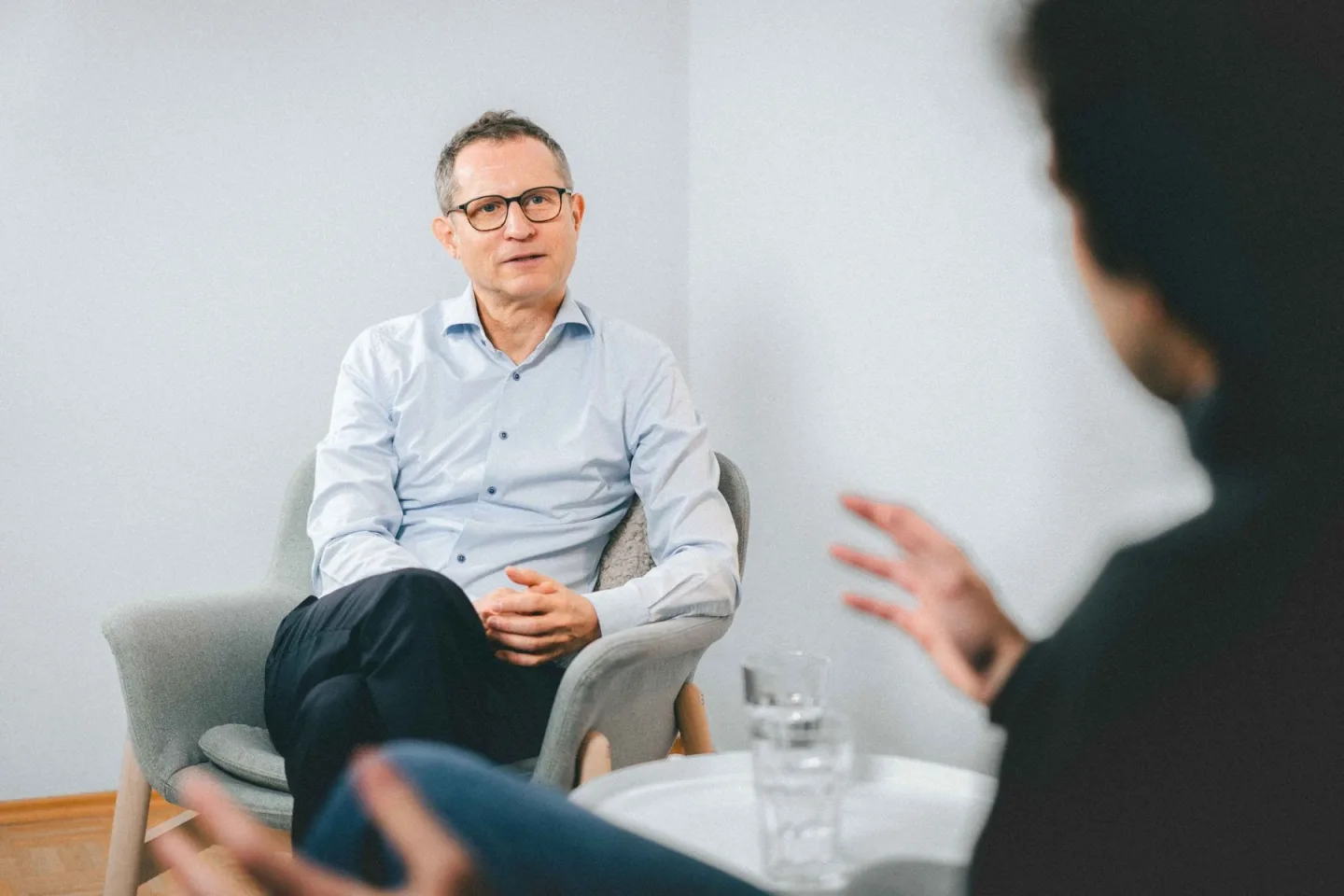 Photo: Valentin Roher
What’s happening in your organisation right now?
I’d love to get to know you and your business through an on-site visit or an informal first conversation.
Related Situations.
- Transformation & Strategic Realignment
When growth outpaces the organisation.
- Leadership & Leadership Development
When leadership begins to lose its impact.
- People & Culture: Organisational Culture & Purpose
When good initiatives need to become meaningful change in everyday practice.
- Organisational Design & Self-Organisation
When responsibilities are clearly defined – but no one truly takes ownership.
- Change Architecture & Organisational Capacity for Change
When change becomes exhausting, the answer isn’t more change – it’s a clearer sense of direction.
- Executive Coaching & Sparring
When leadership becomes personal.